Mohammad Badfar
Faculty Candidate
Department of Industrial & Systems Engineering | Wayne State University
Email: mohammadbadfar@wayne.edu | Phone: +1 (267) 515-8390
Email: mohammadbadfar@wayne.edu | Phone: +1 (267) 515-8390
My research develops adaptive AI frameworks that overcome key barriers to industrial adoption of condition-based maintenance, including imperfect data, evolving system dynamics, and uncertain ROI. Validated in energy and mobility systems, these methods are broadly applicable to other industrial systems, translating large-scale sensor data into actionable insights that enhance reliability, optimize asset performance, and support data-driven operational decisions.
ATOM (Attention for Optimizing Maintenance) marks a milestone in predictive maintenance by leveraging attention mechanisms to unify prediction and optimization within a single deep learning framework [6]. By moving beyond traditional predict-then-optimize methods, ATOM enables instant, near-optimal O&M scheduling for fleets of assets without expert intervention. Evaluations on battery degradation datasets show up to 35% cost reductions, establishing ATOM as a robust approach for intelligent, scalable, and robust decision-making in operations and maintenance.
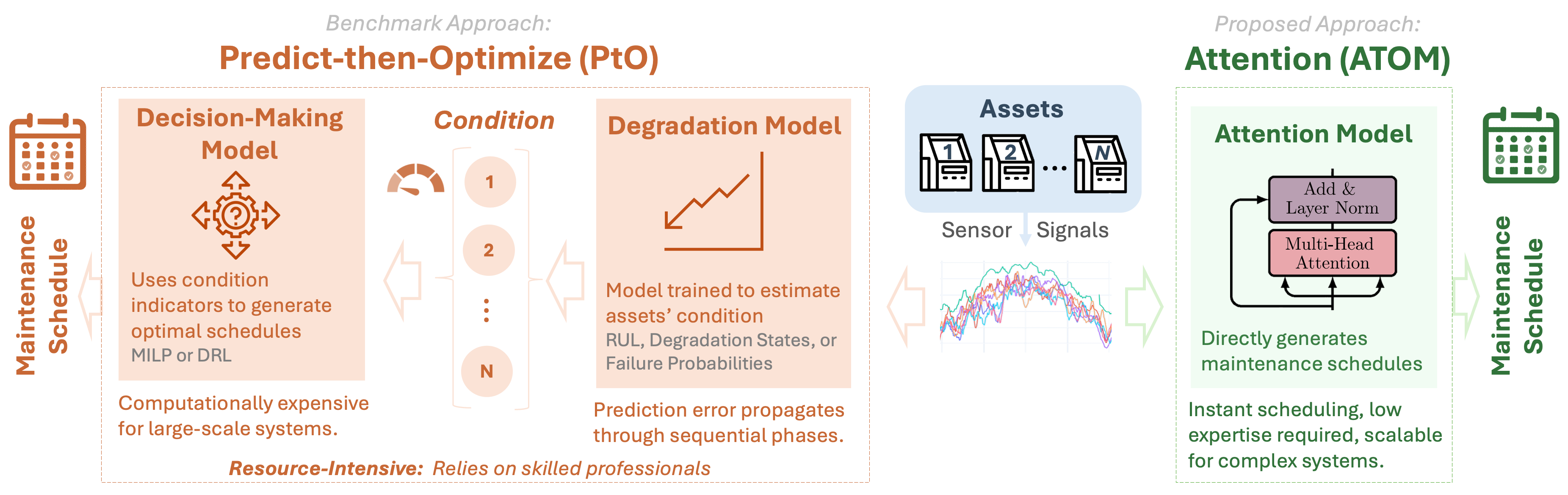
Robust Predictive Models for Industrial Data: Combine ensemble learning with degradation-based features to detect preemptive failures in PV inverters and fleet batteries. Validated with industrial partners, the framework shows strong generalizability and practical impact.
Adaptive AI for Dynamic Operations: Leverages transfer learning and unsupervised domain adaptation to achieve robust performance on unseen scenarios and asset types, improving estimation accuracy across temperatures and chemistries.
My teaching philosophy centers on developing students’ analytical thinking and data-informed decision-making. I view education as a bridge between engineering, business, and computer science—where quantitative reasoning meets strategic insight. Through experiential learning and computational tools like Python and optimization software, I help students connect theory to practice. My goal is to cultivate creative, collaborative learners who apply analytical rigor and managerial judgment to solve real-world challenges.